
Published:
Summary
Desert Strike: Return to the Gulf put you behind the controls of an Apache and somehow made fuel gauges as frightening as missile launchers. Missions mixed destruction, rescue work, and careful route planning across sprawling desert maps, with ammunition and armour constantly demanding attention. Charging in usually ended with a smoking helicopter and wounded pride, while thoughtful pilots learned to raid supplies before causing trouble. Its isometric battlefield, weighty controls, and varied objectives gave the action surprising tactical depth. It was war-gaming with an arcade heartbeat.
What it does well
Excellent mission variety, satisfying helicopter handling, tactical freedom, strong presentation, and resource management that added genuine tension.
Where it falls short
Fuel drained quickly, objectives could become repetitive, controls required practice, and careless exploration was punished severely.
Verdict
A clever blend of arcade combat and tactical planning that made every missile, rescue, and precious drop of fuel matter.
Desert Strike - version notes
Version-specific observations from the gameplay video. Tap a time to jump straight to that moment.
Amiga (3 Beats)
- Origin: the Amiga version was a conversion of the Sega Genesis / Mega Drive original.
- Resource pressure: the manual explicitly frames fuel, ammunition, and armour as the three major performance factors outside pure flying skill.
- Single-player focus: unlike many arcade-style action games, the Amiga version is listed as 1 player only, making it a solo tactical helicopter mission game.
Mega Drive (4 Beats)
- Lead-platform: the Mega Drive version is the original Desert Strike release, not a cut-down port. The Amiga, PC, SNES, and handheld versions all came after it.
- Gulf War timing: arriving soon after the conflict gave its fictional Middle Eastern scenario an unusually provocative edge.
- EA's biggest hit: Desert Strike became a major commercial success and is often cited as one of Electronic Arts' key early-90s console breakthroughs.
- No music: rotor noise, explosions and warning sounds replace continuous music, leaving the battlefield colder and more exposed.
PC (2 Beats)
- Late arrival: DOS players received a polished 1994 conversion after the Mega Drive and Amiga versions.
- Format split: DOS shipped on both 3.5" floppy and CD-ROM, straddling the early-90s transition between formats.
Connected Games
Explore the links between these games.
-
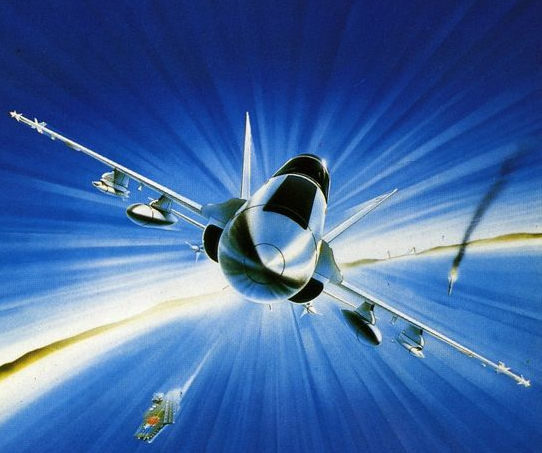 Compare: military flying
F/A-18 Interceptor
1988F/A-18 Interceptor and Desert Strike both offer military flight missions, contrasting jet handling with helicopter combat and rescue work.
-
 Compare: helicopter action
Airwolf
1984Airwolf and Desert Strike both put helicopters at the centre of the action, but Desert Strike adds supplies, rescue work and mission planning.
-
 Compare: combat and rescue
Operation Wolf
1987Operation Wolf and Desert Strike mix shooting with rescuing people, while making ammunition and damage important constraints.
-
 Compare: mission-based combat
Raid Over Moscow
1984Raid Over Moscow and Desert Strike organise combat around military objectives, while differing in viewpoint and how much freedom each mission allows.