
Published:
Summary
Bubble Bobble (1986) turned monster-hunting into something suspiciously adorable. As Bub and Bob, you trapped enemies inside bubbles, popped them for points, and chased fruit across increasingly devious single-screen stages. It looked cheerful, sounded bouncy, and then quietly became vicious. Clever bubble physics, hidden bonuses, multiple endings, and superb two-player cooperation gave it far more depth than its cute exterior suggested. One minute you were helping a friend reach a platform, the next you were stealing their fruit and pretending it was tactical. Simple, charming, and dangerously moreish.
What it does well
Clever bubble mechanics, excellent two-player action, memorable music, colourful presentation, hidden secrets, and huge replay value.
Where it falls short
Later stages became fiendishly difficult, enemy patterns demanded memorisation, and solo play lacked some cooperative magic.
Verdict
A joyful arcade classic that hid surprising depth, devilish difficulty, and brilliant cooperative play beneath its sugary presentation.
Bubble Bobble - version notes
Version-specific observations from the gameplay video. Tap a time to jump straight to that moment.
Arcade (4 Beats)
- Structure: the arcade game is built around 100 single-screen stages, each acting like a tiny puzzle arena rather than a scrolling platform level.
- Invisible currents: every round has unseen air currents that affect how bubbles rise.
- Bubble chemistry: water, lightning, and fire bubbles can become a room-clearing hazard depending on what is inside.
- Legacy chain: Bubble Bobble directly led into Rainbow Islands and later helped spawn the wider Bub and Bob universe.
Atari ST (3 Beats)
- No blueprint: the Amiga / Atari ST team spent weeks playing the arcade version and taking 35mm photos to study how the game worked.
- Joystick-first: the ST gives joystick control, keeping the game closer to arcade habits than the keyboard-heavy 8-bit micro versions.
- Two-player: this version supports 2-player play, which is dependent so much on shared rescue, panic, bubble-popping, and accidental sabotage.
BBC (4 Beats)
- Unreleased oddity: this version was planned for Firebird, but never received a normal shop release. It later circulated through 8-Bit Software.
- Under pressure: like the arcade, taking too long triggers the Hurry Up warning, and brings in the deadly spirit head.
- Tension: the BBC version is described as tougher because trapped enemies escape from bubbles quickly, closer to the arcade machine's pressure.
- Music surprise: music is strong and memorable, which is a nice touch for a machine not always associated with arcade-style soundtrack flash.
Spectrum (3 Beats)
- To the max: despite the 48K limits, the Spectrum conversion includes all 100 levels, making it surprisingly complete for the machine.
- Colour discipline: the arcade's clear single-screen layouts suited the Spectrum well, helping preserve its addictive qualities.
- Two-player survival: this version keeps simultaneous two-player play, which was not guaranteed on every home conversion.
Connected Games
Explore the links between these games.
-
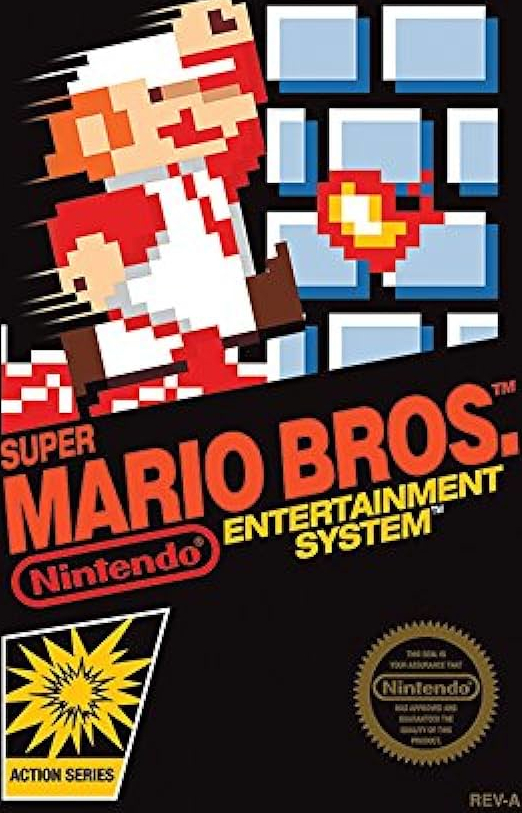 Compare: colourful platforming
Super Mario Bros.
1985Compare the scrolling journeys of Super Mario Bros. with the compact, enemy-filled stages of Bubble Bobble.
-
 Compare: cooperative arcade play
Gauntlet
1985Gauntlet and Bubble Bobble both turn enemy-filled stages into shared challenges, with survival and cooperation at their heart.
-
 Compare: clearing the screen
Tetris
1984Tetris asks you to clear rows of blocks; Bubble Bobble asks you to clear stages of enemies. Compare two compact games built around repeatable rules.
-
 Arcade Collectathons
Gilligan's Gold
1984Both games turn collecting items while avoiding enemies into a race for survival, although Gilligan's Gold favours underground treasure hunting and Bubble Bobble uses bubble-trapping platform action.
-
 Taito connection
Operation Wolf
1987Two contrasting Taito releases: Bubble Bobble (1986) and Operation Wolf (1987).